Hardik Pandya Not Alone! Rohit, SKY, And Bumrah Also Targeted By Mumbai Indians – Mumbai Indians Crisis: Are Senior Stars Like Rohit and Bumrah Uncoachable?
A Dynasty in Decline: The Mumbai Indians Struggle
The Mumbai Indians, a franchise synonymous with excellence and five IPL titles, have found themselves in a period of unprecedented turbulence. Following a dismal IPL 2026 campaign where the team managed only four wins out of fourteen group-stage matches, finishing ninth on the points table, the finger-pointing has begun. While much of the initial criticism was directed squarely at Hardik Pandya‘s captaincy, new reports suggest that the problems run much deeper, involving the most senior figures in the dressing room.
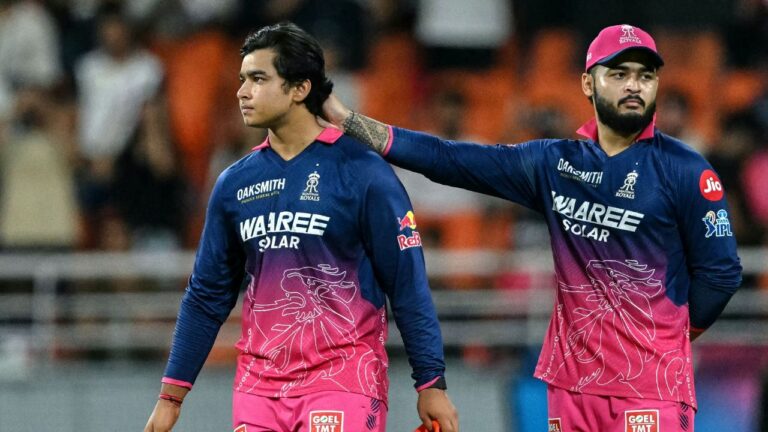
Image Credits: AFP/X
The Challenge of Managing Alpha Leaders
The Mumbai Indians’ roster is packed with some of the most decorated veterans in Indian cricket history. For years, this depth of experience was an asset, expertly managed under the leadership of Rohit Sharma. However, the dynamics shifted dramatically following the controversial transition of the captaincy to Hardik Pandya, who was acquired via a high-profile trade from the Gujarat Titans.
The current dressing room has been described as a ‘room full of alphas.’ With legends like Rohit Sharma, Suryakumar Yadav, and Jasprit Bumrah present, the team structure has faced a significant test. Hardik Pandya now occupies the difficult position of leading players who possess more captaincy experience and hold significant influence, both on and off the field. This clash of leadership styles and internal power dynamics appears to have spilled onto the pitch, manifesting in on-field friction that has hindered the team’s ability to maintain a unified front.
The ‘Uncoachable’ Allegations
According to an exclusive report from The Indian Express, the issue is not just about who holds the captaincy, but rather a broader problem regarding the ‘coachability’ of the senior core. An MI insider revealed that tensions flared following a team talk after a match against the Rajasthan Royals. While the senior players reportedly expressed agreement with the coaching staff’s strategies during meetings, they allegedly failed to execute these data-backed plans when it mattered most—on the field.
“The coaching staff was very clear in their message to the senior players that wherever they play, they need to be coachable. There were many instances where the coaching staff recommended something which was backed by data but players didn’t follow it,” a source noted. This disconnect between tactical planning and on-field execution highlights a breakdown in communication and a lack of alignment that has plagued the franchise since the 2024 season.
Historical Dominance vs. Current Reality
The stark reality of the Mumbai Indians’ current performance is best understood by looking at their past. Historically, MI was a force that either topped the table or remained consistently dominant during the league phases:
- 2015: 10 wins out of 16 matches.
- 2017: 11 wins out of 17 games.
- 2019: 10 wins out of 16 games.
- 2021: 11 wins out of 16 games.
The contrast with the current era is jarring. Since 2024, the team has struggled to find any semblance of consistency. Even when the team managed to secure nine wins in a season, the overall trend has been one of decline, falling far short of the high standards set by the franchise’s legacy.
Individual Underperformance
The collective failure is further reflected in the individual statistics of the players. In previous years, Mumbai Indians consistently produced top-tier performers who competed for the Orange and Purple Caps. Today, the situation is drastically different. Their top batter, Ryan Rickelton, currently sits outside the top fifteen run-getters, and their lead spinner, Allah Ghazanfar, is similarly positioned in the wicket-taking charts.
Despite boasting a lineup filled with World Cup winners and household names, the team has failed to convert talent into results. The Mumbai Indians management is now faced with the urgent task of identifying whether these failures are a result of tactical mismanagement, a cultural breakdown, or a fundamental inability of senior players to adapt to new systems. As the franchise looks toward the future, the need for a swift and decisive resolution has never been more apparent.

Related Articles